Boostaro Official Website › Blog › The dose not printed
The Dose Boostaro Does Not Print
- Seven named ingredients, no milligram figure for any of them.
- No serving size is printed on the sales page either, so a bottle is 30 or 60 days.
- Capsule capacity alone rules out a researched citrulline dose in one capsule.
- Vitamin K2 and nattokinase both matter to a prescriber, and both are unquantified.
- A photograph of the Supplement Facts panel would change this page in an afternoon.
What the label actually shows
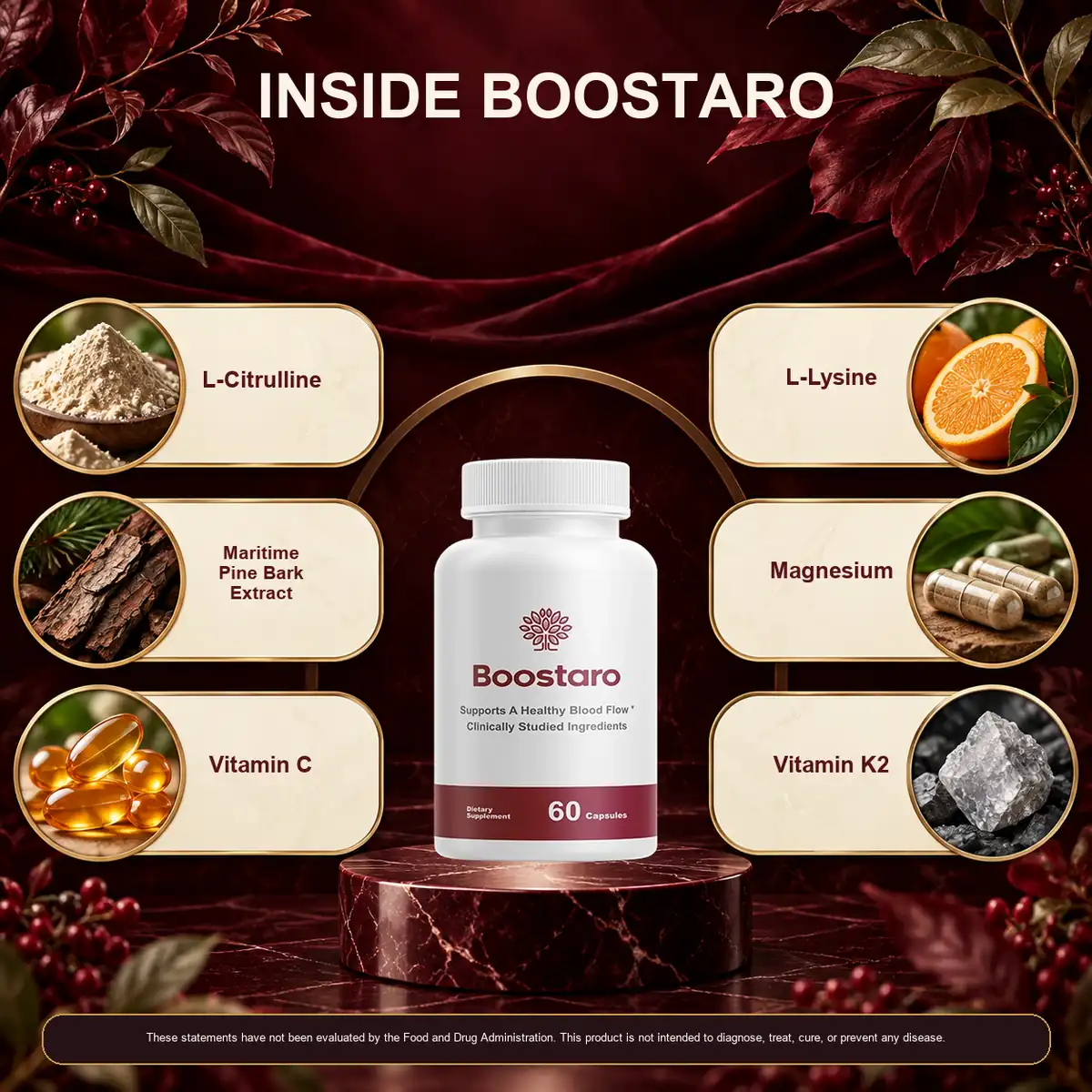
The front of the bottle carries a wordmark, a floral mark, two lines of claim text, the words Dietary Supplement and the figure 60 Capsules. The written sales page names seven actives: L-Citrulline, Maritime Pine Bark extract, Vitamin C, L-Lysine, Magnesium, Vitamin K2 and Nattokinase.
What neither carries is a number against any of those names. No milligrams. No serving size. No servings per container. No percentage of a daily value.
This article is about what that costs a buyer, what can still be worked out, and what would change our assessment. It is the article on this website that costs the product the most, and it is published on the site that sells it for that reason.
What a supplement panel normally carries
A Supplement Facts panel is a standardised table. At minimum it carries a serving size, the number of servings in the container, each ingredient, the amount per serving, and the percentage of a daily value where one has been established.
A proprietary blend is a legal alternative: the ingredients are listed in order of weight, and a single total is given for the blend. That is less useful than per-ingredient amounts and it is still a number, which puts a ceiling on every ingredient in the blend.
What this sales page offers is neither. There is no per-ingredient figure and no blend total, so there is no ceiling on anything, and no arithmetic is possible at all. The FDA's own explainer on supplements is worth reading on what a label is required to do.
The seven gaps, in a table
Here is the whole of the missing information, printed as plainly as we can put it.
| Ingredient | Amount published | Dose used in the research |
|---|---|---|
| L-Citrulline | Not published | 1.5 g a day for one month |
| Maritime Pine Bark | Not published | Standardised extract, combination trials |
| Vitamin C | Not published | 90 mg a day adult male requirement |
| L-Lysine | Not published | No circulatory trial record at any dose |
| Magnesium | Not published | 368 mg a day median, three months |
| Vitamin K2 | Not published | 180 mcg a day for three years |
| Nattokinase | Not published | 2,000 fibrinolytic units a day |
Seven rows, seven identical entries in the middle column. The right-hand column is what the research used, not what this bottle contains, and no honest statement about the second is available.
The arithmetic a buyer can still do
Not being able to check a panel is not the same as knowing nothing. Three pieces of arithmetic survive.
Capsule capacity. A standard size 0 capsule holds roughly 400 to 500 mg of powder depending on density; a larger size 00 holds around 700 to 800 mg. Seven ingredients have to fit inside that, along with any flow agent. So a single capsule cannot contain 1.5 g of citrulline, whatever else is true.
Upper limits. Supplemental magnesium has a tolerable upper intake level of 350 mg a day and total vitamin C one of 2,000 mg, both from the NIH. Those are ceilings you cannot check against an unpublished figure, which matters if you take anything else.
Ingredient count against room. The more names on a panel, the less room each one has. A seven-name panel is a breadth decision rather than a depth one, and that is worth knowing whether or not the amounts are published.
| Capsule size | Approximate powder capacity | What that means here |
|---|---|---|
| Size 1 | About 300 to 400 mg | Seven ingredients would be small fractions |
| Size 0 | About 400 to 500 mg | The common size for a formula like this |
| Size 00 | About 700 to 800 mg | Still well below one researched citrulline dose |
Capacities are general figures for powder-filled capsules and vary with the density of the fill. They are printed here to make one point: physics puts a ceiling on a multi-ingredient capsule.
Why it matters more on this panel than most
An unpublished amount is unhelpful on any product. On this particular panel it is worse than usual, for three specific reasons.
- Vitamin K2 opposes warfarin. A prescriber managing an INR needs to know how much is going in. Not published means not answerable.
- Nattokinase is dosed in activity units, not weight. Even a milligram figure would not settle it, and no unit figure is published either.
- Two ingredients have upper limits that a second supplement can push you past without you knowing.
The safety page lists the interactions in full. The short version is that this is the panel where a missing number has a clinical consequence rather than only a commercial one.
Buy the smallest Boostaro pack first
If the missing panel is a concern, and it is a fair one, the smaller pack costs less to be wrong about and carries the same 60-day window.
60 capsules a bottle · 60-day money-back window
Order Boostaro On The Official WebsiteWhy a manufacturer withholds the numbers
There are three reasons a panel goes unpublished, and it is worth naming all of them rather than assuming the worst or the best.
- Competitive protection. A formula that took work to balance is copyable the moment the amounts are printed. This is the reason manufacturers give, and it is a real one.
- Cost. If an ingredient is present at a fraction of a researched dose, printing the figure invites the comparison. A blend total hides the distribution; publishing nothing hides the total as well.
- Inertia. Marketing pages are frequently written by people who never saw the panel, and the figure is missing from a web page while being perfectly present on the bottle.
The third is common and it is the reason this website keeps asking readers to send a photograph of the physical label. It is also the only one of the three that a buyer can resolve in an afternoon.
What even a blend total would tell you
A proprietary blend is usually criticised, and on a panel like this one it would be an improvement. Here is why.
A blend total is a ceiling. If a label declares a 500 mg blend containing seven ingredients, then no ingredient in it exceeds 500 mg, and the first name listed is present in the largest quantity because the ordering is by weight. That is two real pieces of information from one number.
With no total at all, neither inference is available. The order of the names still tells you something, and it is the only thing left: citrulline first, nattokinase last on the written list.
So the ladder of label transparency runs: per-ingredient amounts, then a blend total with ordered names, then names alone. This product is on the bottom rung, and a buyer should price that in rather than assume it away.
What would change our assessment
We would rewrite this article the same week any of the following arrived.
- A photograph of the Supplement Facts panel from a bottle, showing amounts. That alone would change several pages on this website.
- A blend total, which would at least put a ceiling on every ingredient.
- A fibrinolytic unit figure for the nattokinase.
- A batch certificate of analysis from a named laboratory.
If you have a bottle in front of you and it carries amounts, send a photograph to [email protected]. The page changes and the review date moves, which is the visible part of the correction process described on the about page.
How to ask a manufacturer for a number
This works on any supplement, and it is worth doing before a large purchase rather than after one.
- Ask for the Supplement Facts panel as an image. It exists, because it is printed on the bottle. A seller that will not send one has told you something.
- Ask what the capsule size is. It bounds everything else.
- Ask for the standardisation on any botanical extract. For pine bark that is procyanidin content.
- Ask whether a batch certificate exists and who issued it.
Four questions, one email. The answers, or the absence of them, will tell you more than any amount of marketing copy, and the exercise transfers to every product on the shelf.
Where this leaves us, as the seller
We sell this product and we have just spent an article explaining its weakest point. The reasoning is simple enough to state.
A buyer who finds out about the missing panel after spending money on six bottles is entitled to feel misled, and would be right. A buyer who knows before ordering can choose the smallest pack, use the 60-day window, and judge it on its own terms. The second transaction is better for everyone involved, including us.
The FTC's health products guidance sets the standard that a claim has to match its evidence. The version of that standard we apply here is narrower: no number appears on this website that we cannot source, including the ones that would help us sell.
Sources for this article
- Cormio L, De Siati M, Lorusso F, Selvaggio O, Mirabella L, Sanguedolce F, Carrieri G. Oral L-citrulline supplementation improves erection hardness in men with mild erectile dysfunction. Urology. 2011;77(1):119-22. https://pubmed.ncbi.nlm.nih.gov/21195829/
- Zhang X, Li Y, Del Gobbo LC, Rosanoff A, Wang J, Zhang W, Song Y. Effects of Magnesium Supplementation on Blood Pressure: A Meta-Analysis of Randomized Double-Blind Placebo-Controlled Trials. Hypertension. 2016;68(2):324-33. https://pubmed.ncbi.nlm.nih.gov/27402922/
- Knapen MH, Braam LA, Drummen NE, Bekers O, Hoeks AP, Vermeer C. Menaquinone-7 supplementation improves arterial stiffness in healthy postmenopausal women. A double-blind randomised clinical trial. Thromb Haemost. 2015;113(5):1135-44. https://pubmed.ncbi.nlm.nih.gov/25694037/
- Kim JY, Gum SN, Paik JK, Lim HH, Kim KC, Ogasawara K, Inoue K, Park S, Jang Y, Lee JH. Effects of nattokinase on blood pressure: a randomized, controlled trial. Hypertens Res. 2008;31(8):1583-8. https://pubmed.ncbi.nlm.nih.gov/18971533/
- National Institutes of Health, Office of Dietary Supplements. Magnesium: Fact Sheet for Consumers. https://ods.od.nih.gov/factsheets/Magnesium-Consumer/
- National Institutes of Health, Office of Dietary Supplements. Vitamin C: Fact Sheet for Consumers. https://ods.od.nih.gov/factsheets/VitaminC-Consumer/
- National Institutes of Health, Office of Dietary Supplements. Vitamin K: Fact Sheet for Consumers. https://ods.od.nih.gov/factsheets/VitaminK-Consumer/
- Federal Trade Commission. Health Products Compliance Guidance. 2022. https://www.ftc.gov/business-guidance/resources/health-products-compliance-guidance
- U.S. Food and Drug Administration. Questions and Answers on Dietary Supplements. https://www.fda.gov/food/information-consumers-using-dietary-supplements/questions-and-answers-dietary-supplements

Every page, every journal post, the bottle facts and the ingredients go through review by Dr. Rachel Rubin, MD before they ship. We write these pages from the Boostaro bottle and the distributor’s own paperwork, cite published research for every named ingredient, and print “not published” wherever a figure is not disclosed rather than estimating it. Where the manufacturer’s marketing art claims more than the bottle supports, we print both and say which one we follow. Corrections are made on the page itself and the review date moves forward. Write to [email protected]. Last reviewed September 2026 by Dr. Rachel Rubin, MD.