Boostaro Official Website › Blog › Clinically studied ingredients
What Does “Clinically Studied Ingredients” Mean on the Boostaro Bottle?
It means some of the seven named ingredients have been studied one at a time, at amounts that Boostaro does not print. It does not mean the finished capsule was tested. The capsule itself has no clinical trial. L-lysine has no trial for this purpose, and the pine bark evidence is mixed.
Want to read the terms first?
The checkout shows the pack totals and the 60-day guarantee terms, so you can read them before you decide.
See today’s price and guaranteeEarnings disclosure: this website earns when an order goes through its checkout. It is a USA Authorized Boostaro Retailer, not the manufacturer.
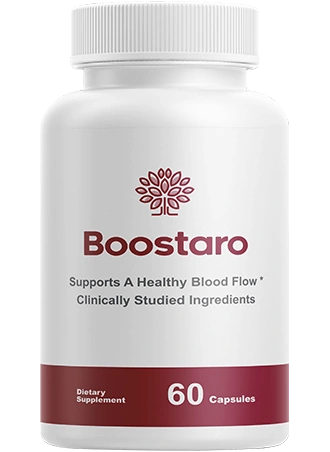
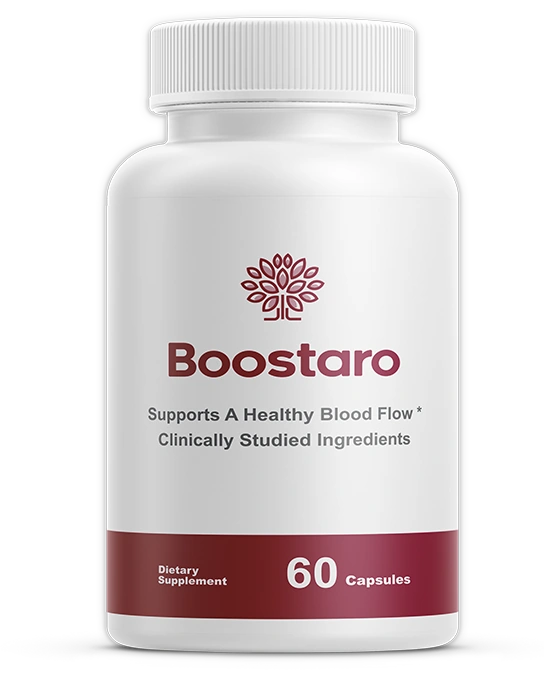
- Three lines are printed on the bottle: “Supports a healthy blood flow”, “Boosts bedroom stamina” and “Clinically studied ingredients”.
- The third line refers to the ingredients one by one, not to the finished product.
- Boostaro itself has never been tested in a clinical trial.
- The amounts in the capsule are not published, so they cannot be compared with any trial dose.
- L-lysine has no randomised trial record in circulatory or sexual function, and a Cochrane review found the pine bark evidence insufficient.
- Boostaro is a dietary supplement. It is not FDA approved, and it does not claim to treat any disease.
What does the bottle actually say?
Start with the exact words, because the exact words are the fairest place to begin. The bottle prints three short lines.
- “Supports a healthy blood flow”
- “Boosts bedroom stamina”
- “Clinically studied ingredients”
The vendor’s listing artwork uses other lines, such as “Enhances night performance”, “Nourishes vital energy” and “100% natural and effective”. Those are not on the bottle, and this website does not repeat them. Where the artwork claims more than the bottle does, the bottle wins.
The third bottle line is the one that does the quiet work. It sounds like a sign of testing. So the useful question is what sort of testing, on what, and at what amount.
What does “studied” cover, and what does it leave out?
Read the line again. It says the ingredients were studied. It does not say the product was studied. Those are two different claims, and only the first one is on the bottle.
A supplement is a mix of parts. Each part might have a paper written about it. That is how a seven-part capsule can honestly carry the words. But a mix can behave differently from its parts, and the amounts matter. The papers were written about named doses. The bottle does not print its doses.
So the safest plain reading is this. Some ingredients on the panel have been studied on their own. The studies used amounts that cannot be matched to this capsule. No trial has looked at Boostaro as a whole. All three parts of that sentence are true together.
Which studies sit behind each name?
Here is a plain table of the research named in this website’s fact sheet. It shows who was studied, for how long, and what was found, in everyday words.
| Ingredient | The study | Who and how long | What it found |
|---|---|---|---|
| L-Citrulline | Cormio and colleagues, 2011 | 24 men with mild erectile dysfunction, one month, 1.5 g a day | Erection hardness rose in 12 of 24 men, against 2 of 24 on placebo. The authors called it modest. |
| Maritime pine bark | Stanislavov and colleagues, 2008 | A crossover trial of pine bark with L-arginine | Improved scores. It tested a mix, was funded by the supplier, and cannot show what pine bark does alone. |
| Maritime pine bark | Cochrane review, 2020 | 27 trials in 10 conditions | Evidence found insufficient for any chronic disorder. |
| Vitamin C | Ashor and colleagues, 2014 | Reviews of randomised trials | Helped vessel lining function in people with vascular disease or diabetes, not in healthy people. |
| L-Lysine | No trial for this purpose | None | No randomised trial record in circulatory or sexual function. |
| Magnesium | Zhang and colleagues, 2016 | 34 double-blind trials, median 368 mg a day, three months | A drop of about 2 mmHg in systolic pressure. |
| Vitamin K2 | Knapen and colleagues, 2015 | 244 healthy postmenopausal women, 180 micrograms a day, three years | A small improvement in arterial stiffness. |
| Nattokinase | Kim and colleagues, 2008 | 86 adults with raised blood pressure, 2,000 fibrinolytic units a day, eight weeks | A fall of about 5.5 mmHg in systolic pressure. |
Do the trial amounts match the capsule?
Nobody can say. That is the plain answer, and it follows from the first column of the table above. For every ingredient, the amount on the Boostaro label is not published.
The citrulline trial used 1.5 g a day. Inside a seven-ingredient capsule, that would be most of the capsule. The nattokinase trial used a count of fibrinolytic units, which the label does not give either. The K2 trial used a named form of the vitamin, and the label does not name its form.
That is why the third bottle line cannot carry the weight a shopper might put on it. A study is a result at a dose. Remove the dose and what is left is a name.
Is “studied” the same as “proven”?
No. A study can find a benefit, a small benefit, no benefit, or a result that is hard to read. The word “studied” says only that someone looked.
Look at the table again. One review of pine bark across 27 trials found the evidence insufficient. The lysine row is empty for this purpose. The vitamin C result applied to people with vessel disease or diabetes, not to healthy people. The citrulline trial was small and single-centre.
None of this makes the panel a bad idea. It means the phrase on the bottle is a gentle one, and a careful reader keeps it gentle. The research is a reason to look at the ingredients, not a reason to expect a result.
Who paid for the studies, and does it matter?
It can. The pine bark crossover study was funded by the supplier of the ingredient it tested. That does not make it wrong. It does mean one positive result deserves less weight, especially when a Cochrane review of the same ingredient was cooler.
A simple rule helps with any label. Prefer reviews that pool many trials over single trials. Prefer independent funding. Ask who paid when you can find out. This website prints funding where the sources say it.
Also notice what is missing: any study paid for by the maker of this particular capsule. If one exists, it has not been supplied to this website. If it appears, we will name the lab, the design and the amounts.
How can you read this kind of claim on any bottle?
Use four short questions. They work for Boostaro and for every other supplement on a shelf.
- Studied who? Was the study done on men like you, or on a different group?
- Studied how? A single small trial, or a pool of many?
- Studied at what dose? Does the bottle print an amount you can compare?
- Studied for how long? Is that longer than the refund window?
If a bottle cannot answer the third question, the first line of the label is doing more work than the research. For Boostaro the third answer is “not published”. That is a fair reason to start small, to read the Supplement Facts panel on the bottle when it arrives, and to use the 60-day window to judge it for yourself.
Frequently asked questions
What does clinically studied ingredients mean on the Boostaro bottle?
Some of the seven named ingredients have been studied individually, at amounts that the label does not print. The capsule as a whole has not.
Has Boostaro itself been in a clinical trial?
No. Only some of its ingredients have been studied, one at a time.
Which ingredient in Boostaro has the most research behind it?
L-citrulline has the only trial on the panel that studied the thing the bottle talks about, in 24 men with mild erectile dysfunction. It was small.
Which ingredient has the weakest evidence?
L-lysine. No randomised trial record exists for it in circulatory or sexual function.
Are the amounts in the capsule the same as in the studies?
Nobody can say. The amounts in the capsule are not published.
Does this mean Boostaro works?
No. The studies describe single ingredients at named doses. They do not show that this capsule produces a result.
Plain facts. Boostaro is a dietary supplement. It is not FDA approved, and no dietary supplement is. These statements have not been evaluated by the Food and Drug Administration, and this product is not intended to diagnose, treat, cure or prevent any disease. Nothing on this page is medical advice. Talk to a doctor before use if you take medicine or have a health condition.
Our view
“Clinically studied ingredients” is a careful phrase, and it is true as far as it goes. It tells you that research exists on some of the parts. It does not tell you what is in the capsule, and it does not tell you what the capsule will do.
That is a smaller promise than the phrase can sound. We think the honest way to treat it is as a pointer to the ingredients page, where the studies are named and linked, and where each one is set beside its dose.
If that level of evidence is acceptable to you, the 60-day window lets you test it on your own terms. If you want a published dose for each ingredient first, this label does not meet that bar.
Judge it on your own terms
Open the checkout, read the totals and the guarantee, and take your time. Leaving without buying is always an option.
See today’s price and guaranteeEarnings disclosure: this website earns when an order goes through its checkout. It is a USA Authorized Boostaro Retailer, not the manufacturer.
Sources for this article
- Cormio L, De Siati M, Lorusso F, Selvaggio O, Mirabella L, Sanguedolce F, Carrieri G. Oral L-citrulline supplementation improves erection hardness in men with mild erectile dysfunction. Urology. 2011;77(1):119-22. https://pubmed.ncbi.nlm.nih.gov/21195829/
- Stanislavov R, Nikolova V, Rohdewald P. Improvement of erectile function with Prelox: a randomized, double-blind, placebo-controlled, crossover trial. Int J Impot Res. 2008;20(2):173-80. https://pubmed.ncbi.nlm.nih.gov/17703218/
- Robertson NU, Schoonees A, Brand A, Visser J. Pine bark (Pinus spp.) extract for treating chronic disorders. Cochrane Database Syst Rev. 2020;9(9):CD008294. https://pubmed.ncbi.nlm.nih.gov/32990945/
- Ashor AW, Lara J, Mathers JC, Siervo M. Effect of vitamin C on endothelial function in health and disease: a systematic review and meta-analysis of randomised controlled trials. Atherosclerosis. 2014;235(1):9-20. https://pubmed.ncbi.nlm.nih.gov/24792921/
- Zhang X, Li Y, Del Gobbo LC, Rosanoff A, Wang J, Zhang W, Song Y. Effects of Magnesium Supplementation on Blood Pressure: A Meta-Analysis of Randomized Double-Blind Placebo-Controlled Trials. Hypertension. 2016;68(2):324-33. https://pubmed.ncbi.nlm.nih.gov/27402922/
- Knapen MH, Braam LA, Drummen NE, Bekers O, Hoeks AP, Vermeer C. Menaquinone-7 supplementation improves arterial stiffness in healthy postmenopausal women. A double-blind randomised clinical trial. Thromb Haemost. 2015;113(5):1135-44. https://pubmed.ncbi.nlm.nih.gov/25694037/
- Kim JY, Gum SN, Paik JK, Lim HH, Kim KC, Ogasawara K, Inoue K, Park S, Jang Y, Lee JH. Effects of nattokinase on blood pressure: a randomized, controlled trial. Hypertens Res. 2008;31(8):1583-8. https://pubmed.ncbi.nlm.nih.gov/18971533/
- Chi CC, Wang SH, Delamere FM, Wojnarowska F, Peters MC, Kanjirath PP. Interventions for prevention of herpes simplex labialis (cold sores on the lips). Cochrane Database Syst Rev. 2015;(8):CD010095. https://pubmed.ncbi.nlm.nih.gov/26252373/
- Federal Trade Commission. Health Products Compliance Guidance. 2022. https://www.ftc.gov/business-guidance/resources/health-products-compliance-guidance