Boostaro Official Website › Blog › Citrulline against arginine
L-Citrulline vs L-Arginine: Which One Works?
- Arginine taken by mouth is largely destroyed by arginase before it reaches the blood.
- Citrulline bypasses that enzyme and raises plasma arginine more effectively.
- The relevant trial used 1.5 g a day for one month in 24 men with mild difficulty.
- Boostaro publishes no amount for citrulline or for anything else on its panel.
- Nitrates and PDE5 inhibitors are a prescriber conversation, not a website one.
Two amino acids, one job
Arginine is the amino acid the body uses to make nitric oxide. Nitric oxide relaxes the smooth muscle around a blood vessel, the vessel widens, and flow through it increases. If you wanted to support that pathway with a supplement, arginine is the obvious thing to take.
Citrulline is one step back. The body converts citrulline into arginine in the kidney, and that arginine then feeds the same pathway. It is the indirect route, and on paper it looks like the worse idea.
In practice it is the better one, and the reason is a piece of pharmacology worth understanding before you read any product page in this category.
Why swallowing arginine mostly does not work
Arginine taken by mouth runs into an enzyme called arginase in the gut wall and the liver. A large share of the dose is broken down before it reaches the bloodstream, which is first-pass metabolism. The result is that plasma arginine rises much less than the size of the dose suggests, and it rises inconsistently between people.
Citrulline is not a substrate for arginase. It passes through, is taken up by the kidney, and is converted to arginine there, downstream of the enzyme that was destroying the arginine you swallowed.
Schwedhelm and colleagues measured this directly in a randomised study in Br J Clin Pharmacol in 2008, comparing oral citrulline and oral arginine on plasma arginine and nitric oxide metabolites. Gram for gram, citrulline raised plasma arginine more effectively than arginine did.
| L-Arginine | L-Citrulline | |
|---|---|---|
| Route | Direct substrate | Converted to arginine in the kidney |
| First-pass loss | Substantial, via arginase | Not a substrate for arginase |
| Plasma arginine per gram | Lower and more variable | Higher and more consistent |
| Typical supplement dose | 3 to 6 g | 1.5 to 6 g |
| Tolerability | Stomach upset common at higher doses | Generally better tolerated |
| Why panels use it | Historical, and it is cheap | Better pharmacokinetics |
This is the whole argument for citrulline appearing first on a panel like this one. It is a real advantage and it is about absorption rather than about potency.
What the citrulline trials actually found
The trial people quote is small, and it is worth reading precisely rather than in summary.
Cormio and colleagues (Urology, 2011) ran a single-blind crossover study in 24 men with mild erectile difficulty. One month of placebo, then one month of 1.5 g of L-citrulline a day. Twelve of the 24 men moved up a category on the erection hardness score on citrulline, against two of 24 on placebo. The authors described the effect as less than a PDE5 inhibitor would produce, and called citrulline safe and psychologically well accepted.
- 24 men is a small study, and a single centre.
- One month is a short arm.
- Mild difficulty was the entry criterion, so it says nothing about anyone else.
- 1.5 g a day is the dose the result belongs to.
Separately, a systematic review of blood pressure trials found citrulline produced reductions that were real but small and dependent on dose. Both findings point the same way: a genuine effect, modest in size, at grams rather than milligrams.
The question that decides everything
Here is where a product page usually stops and this one keeps going. Every citrulline result above belongs to a specific amount. So the only question that matters when you pick up a bottle is how much citrulline is in it.
On this label, that figure is not published. Neither the bottle front nor the sales page carries a milligram figure for citrulline or for any of the other six ingredients.
A capsule carrying seven ingredients has limited room. Reaching 1.5 g of one of them would take most of a large capsule on its own. That is an observation about physical capacity rather than an accusation, and it is why the missing number matters more here than it would on a single-ingredient product.
The ingredients page prints the trial dose beside every name on the panel for exactly this reason, and the companion article on the missing numbers goes through what a buyer can still work out.
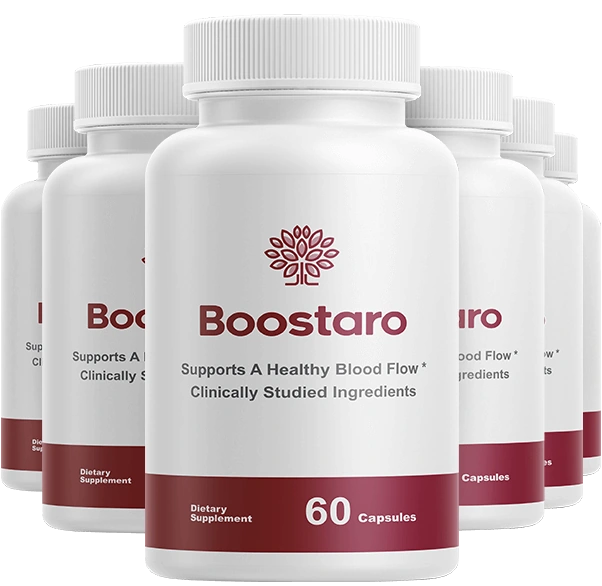
Boostaro leads its panel with L-Citrulline
Seven named actives, no published amounts, and a 60-day window from purchase to decide what that is worth to you.
60 capsules a bottle · 60-day money-back window
Order Boostaro On The Official WebsiteWhere citrulline comes from in food
Citrulline is named after watermelon, from Citrullus, which is where it was first isolated. Watermelon flesh and rind both contain it, and the amount varies enormously by variety and ripeness.
Two things follow. Reaching a supplemental dose from fruit is impractical: you would be eating a lot of watermelon, daily, for months. And the food source explains why this ingredient is one of the more benign on a supplement panel, because people have been eating it in ordinary quantities forever.
Arginine is more widely distributed. Nuts, seeds, poultry, fish and dairy all carry it, and an ordinary mixed diet supplies several grams a day. That is worth knowing, because it puts a supplement dose in context: you are adding to an existing intake rather than starting from zero.
Citrulline malate, and the other forms on shelves
Three forms turn up on labels and they are not interchangeable, which matters if you are comparing products rather than reading one.
- L-Citrulline. The free amino acid. This is what the erectile function trial used, at 1.5 g a day.
- Citrulline malate. Citrulline bonded to malic acid, usually in a 2:1 or 1:1 ratio. Popular in exercise products. A 6 g dose of 2:1 citrulline malate contains roughly 4 g of citrulline, so the label figure overstates the amino acid.
- L-Arginine and its salts. Arginine HCl, arginine AKG and so on. All run into the same first-pass problem described above.
This panel names L-Citrulline, which is the form the relevant research used. That is a small point in its favour and it is worth crediting, because plenty of products in this category name a malate and quote a free-amino-acid trial beside it.
What none of that fixes is the missing amount. A correctly chosen form at an unknown dose is still an unknown dose.
What citrulline does not do
Four things worth ruling out, because the category implies all of them somewhere.
- It is not a PDE5 inhibitor. A prescription drug acts on an enzyme within an hour. An amino acid feeds a substrate pool over weeks. They are not comparable and the trial authors said so themselves.
- It does not raise testosterone. Nothing in the pathway touches hormone production, and no reputable trial claims it does.
- It does not treat erectile dysfunction. That is a diagnosis, and a supplement may not claim to treat one.
- It does not repair a damaged endothelium. Supplying substrate helps only if substrate was the limiting factor, which is not established in healthy people.
Those four sentences are the difference between a page that respects a reader and a page that sells to one. Both can mention the same trial.
Who should not take either one
Nitrates. If you take a nitrate for angina, the nitric oxide pathway is already being worked on pharmacologically. Do not add a citrulline or arginine supplement without asking the prescriber. The same conversation applies to anyone taking a PDE5 inhibitor.
- Anyone on blood pressure medicine. Citrulline has a small blood pressure effect. Worth mentioning at the next review rather than discovering by accident.
- Anyone with kidney disease. The conversion to arginine happens in the kidney, and free amino acid supplements are a conversation to have with a clinician.
- Anyone under 18. Both this product and this article are for adults.
- Anyone with a new or sudden change. The research is consistent: difficulty here frequently precedes a cardiovascular diagnosis. The NIDDK page is a good non-commercial place to start.
What this means for the panel in front of you
Put the pieces together and you get a clear-eyed view of one ingredient on one label.
- Citrulline over arginine is the right choice on the pharmacology. The panel gets that part right.
- The evidence is real and modest. One small trial in mild cases, plus blood pressure reviews showing small dose-dependent effects.
- The dose is unknown here, so none of that evidence can be attached to this bottle with any confidence.
- It is well tolerated, which is why it appears on so many panels.
That is three quarters of a good ingredient story and one missing number. Whether that is enough to buy on is a decision this website has an obvious interest in, which is why the whole of the arithmetic is printed rather than the conclusion.
The bottom line
L-citrulline is the better of the two amino acids for this purpose and the panel is right to lead with it. The trial behind it is small, one month long, and used 1.5 g a day in men with mild difficulty. The NIH's general supplement guidance applies here as much as anywhere: a supplement is an addition to a diet rather than a substitute for medical care.
If you are choosing between products in this category, the question to ask is not whether citrulline is on the panel. It is how much, and what the page selling it says when the answer is uncomfortable.
Sources for this article
- Schwedhelm E, Maas R, Freese R, Jung D, Lukacs Z, Jambrecina A, Spickler W, Schulze F, Boger RH. Pharmacokinetic and pharmacodynamic properties of oral L-citrulline and L-arginine: impact on nitric oxide metabolism. Br J Clin Pharmacol. 2008;65(1):51-9. https://pubmed.ncbi.nlm.nih.gov/17662090/
- Cormio L, De Siati M, Lorusso F, Selvaggio O, Mirabella L, Sanguedolce F, Carrieri G. Oral L-citrulline supplementation improves erection hardness in men with mild erectile dysfunction. Urology. 2011;77(1):119-22. https://pubmed.ncbi.nlm.nih.gov/21195829/
- Mirenayat MS, Moradi S, Mohammadi H, Rouhani MH. Effect of L-Citrulline Supplementation on Blood Pressure: a Systematic Review and Meta-Analysis of Clinical Trials. Curr Hypertens Rep. 2018;20(11):98. https://pubmed.ncbi.nlm.nih.gov/30284051/
- Gandaglia G, Briganti A, Jackson G, Kloner RA, Montorsi F, Montorsi P, Vlachopoulos C. A systematic review of the association between erectile dysfunction and cardiovascular disease. Eur Urol. 2014;65(5):968-78. https://pubmed.ncbi.nlm.nih.gov/24011423/
- National Institute of Diabetes and Digestive and Kidney Diseases. Erectile Dysfunction (ED). https://www.niddk.nih.gov/health-information/urologic-diseases/erectile-dysfunction
- National Institutes of Health, Office of Dietary Supplements. Dietary Supplements: What You Need to Know. https://ods.od.nih.gov/factsheets/WYNTK-Consumer/
Every page, every journal post, the bottle facts and the ingredients go through review by Dr. Rachel Rubin, MD before they ship. We write these pages from the Boostaro bottle and the distributor’s own paperwork, cite published research for every named ingredient, and print “not published” wherever a figure is not disclosed rather than estimating it. Where the manufacturer’s marketing art claims more than the bottle supports, we print both and say which one we follow. Corrections are made on the page itself and the review date moves forward. Write to [email protected]. Last reviewed September 2026 by Dr. Rachel Rubin, MD.